„Works and Days”
Interactive Installation
Speakers, wire, single board computer, field recordings, ultrasonic sensors
2024
200x180x60cm
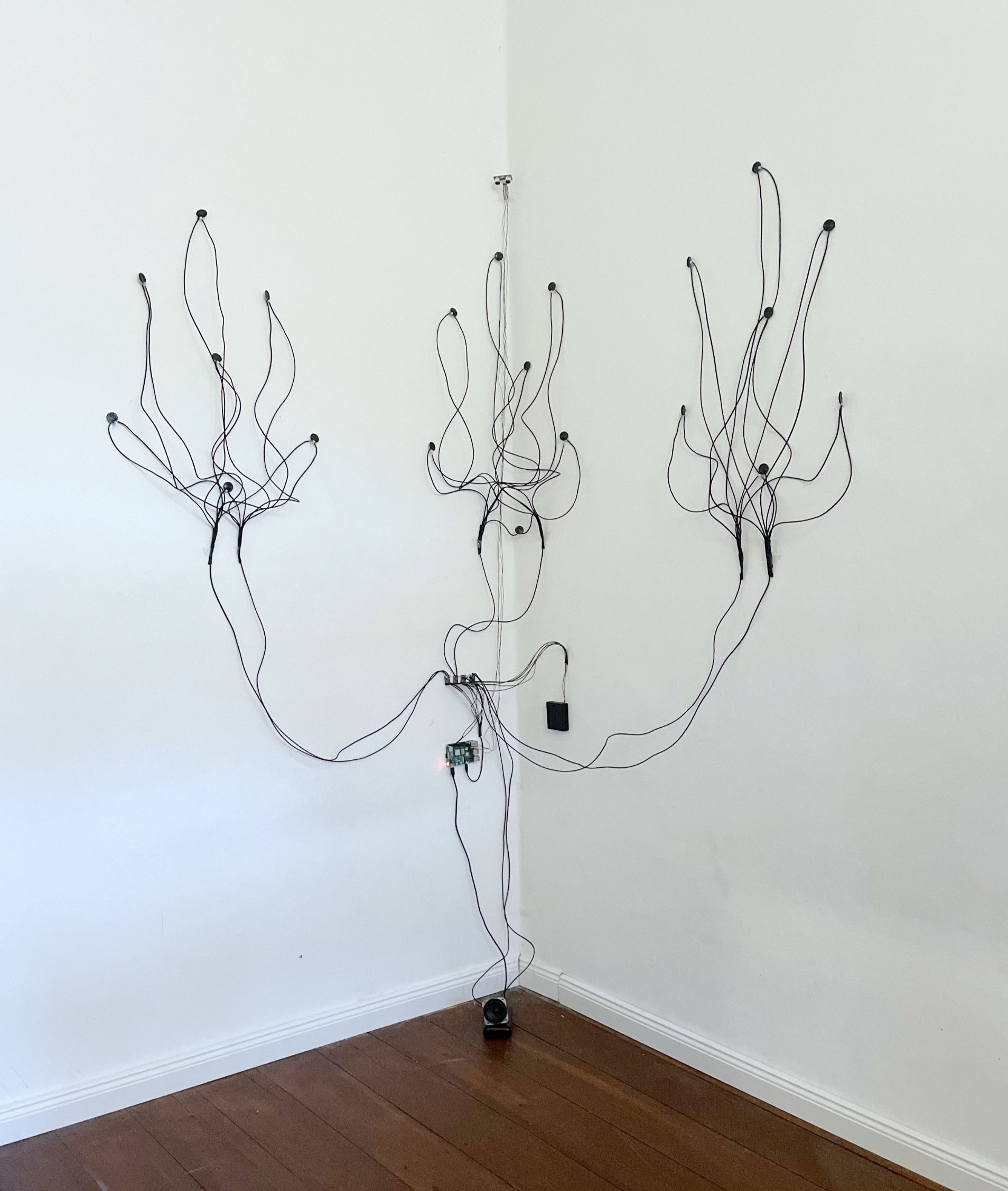
Field recordings captured across Italy and Greece are diffused through clusters of mini speakers creating three “Swarms.” Various cicada audios positioned around a central speaker that echoes city sounds: the rumble of construction, the murmur of distant voices, the steady thrum of traffic. As visitors move through the space, PIR sensors track movement, and a Raspberry Pi microprocessor running code subtly amplifies the closest “Swarm,” while quieting others. This interplay invites the viewer into a sensation of being both observed and absorbed by the sounds of industry and nature around them. Conceptualized while listening to meditative works by John Cage and Alice Coltrane. This installation draws one into a meditative state, encouraging one to bask in the sonic layers of a living code of calls, hums, and unseen rhythms that make up the fabric of our daily lives.
„GMO Tomato”
Digital Maquette
2025
In 2007, scientists engineered a tomato to produce geraniol during the fruit's ripening stage, a rose-like compound found in flowers and often used in perfumery. An untrained panel then tasted the transgenic fruit and preferred them over controls. This work examines humanity’s interventions into nature and the modifications we explore and endure.
As we reshape the planet to meet the demands of overpopulation, climate instability, and resource scarcity, even our sensory realities are changing. What does it mean to replace ancestral scents with synthetic ones? What kind of Earth are we building when its biology becomes authored?
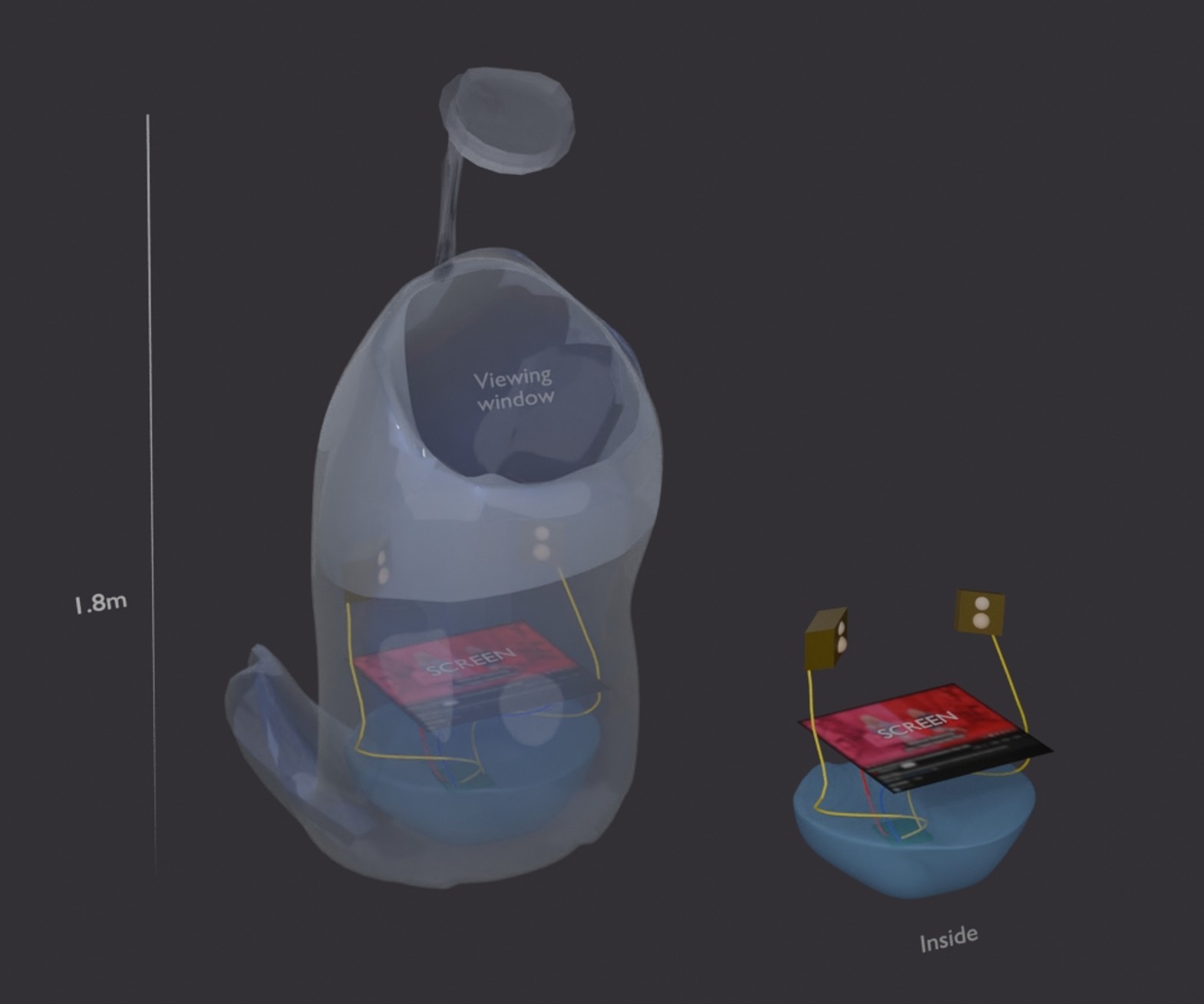
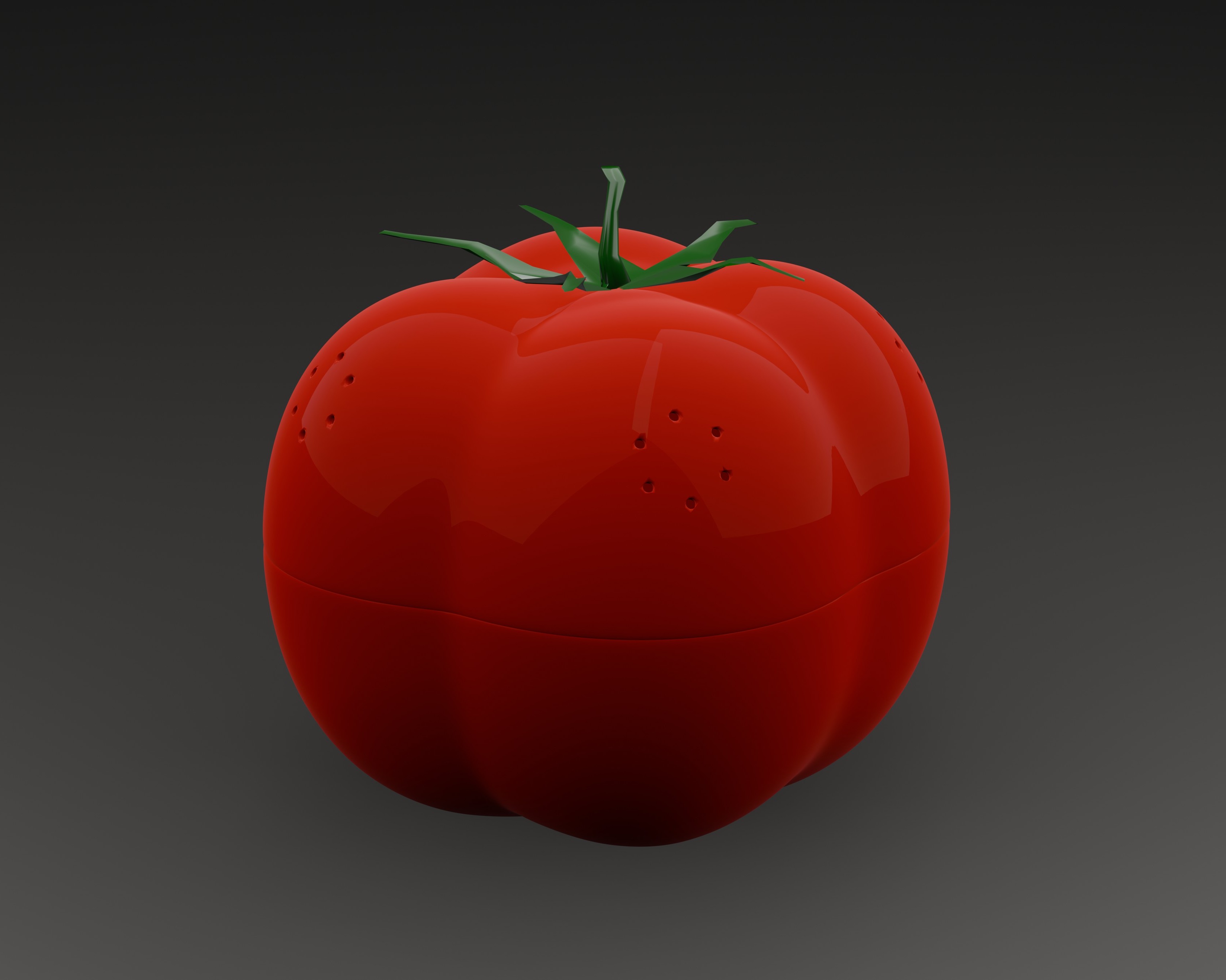
For this work I crafted a scent profile of the transgenic fruit using traditional perfumery techniques and aroma compounds. This scent reimagines the tomato not as it was, but as it is becoming, a new species constructed through biotech. The final work will be presented as a 3D-printed diffuser (the blender rendering is shown here) containing the scent compounds for the viewer to smell: a vine tomato accord with geraniol to mimic the profile of the GMO tomato. The result is a speculative olfactory artifact of our increasingly transgenic future.
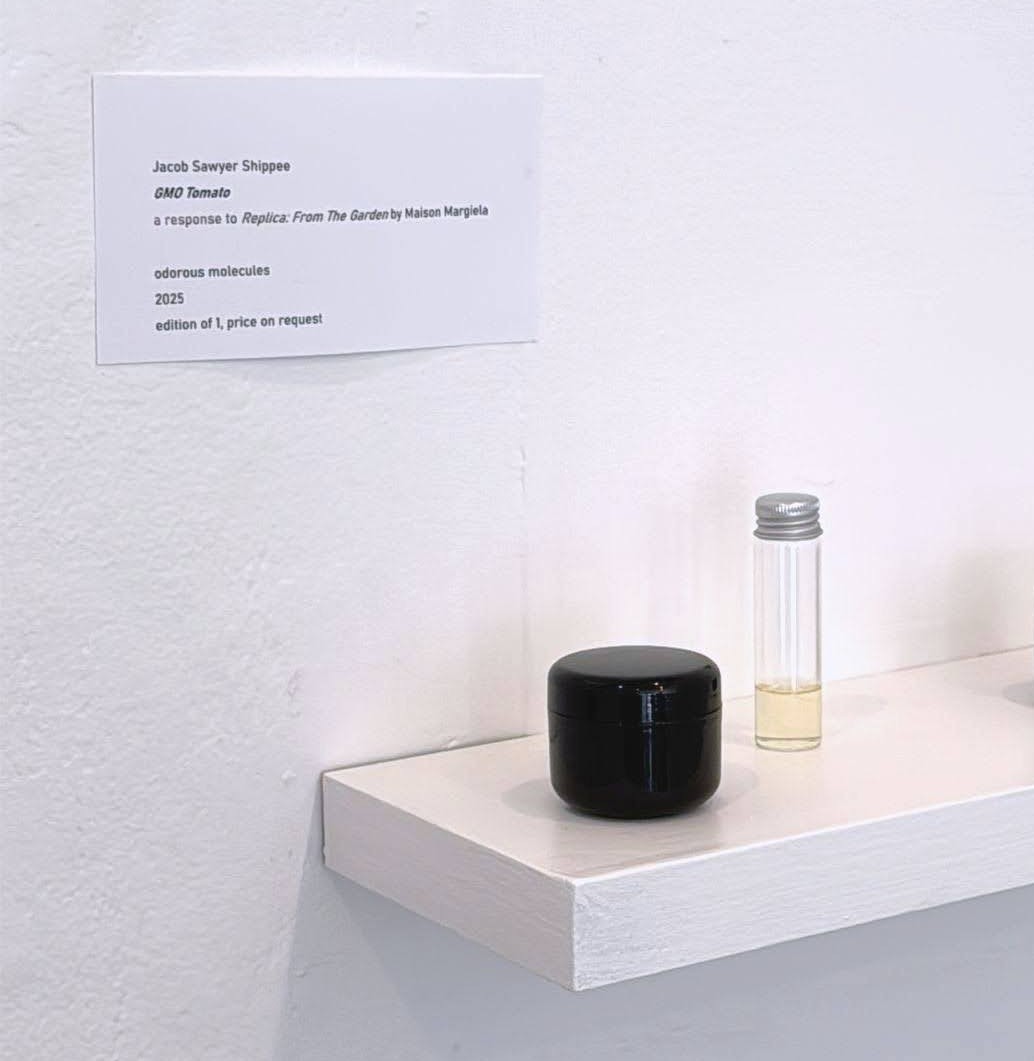
Exhibited in Volatile Derivatives at Olfactory Art Keller, New York City, USA, 2025.
 Aroma compounds used:
 Geraniol, Hexyl cinnamal, Linalyl acetate, Dimethyl cyclohexenecarboxaldehyde, Limonene, Linalool, Trimethylphenyl dioxane, 4-tert-Butylcyclohexyl acetate, Isobutyl benzyl propanal, Citral, Citronellal, Citronellol, Eucalyptol, Hexyl salicylate, Hydrogenated methyl abietate, Peonile, α-Pinene, α-Terpinene, Terpinyl acetate, Camphene, Lauric aldehyde, Geranyl acetate, Myrcene, Terpinolene.
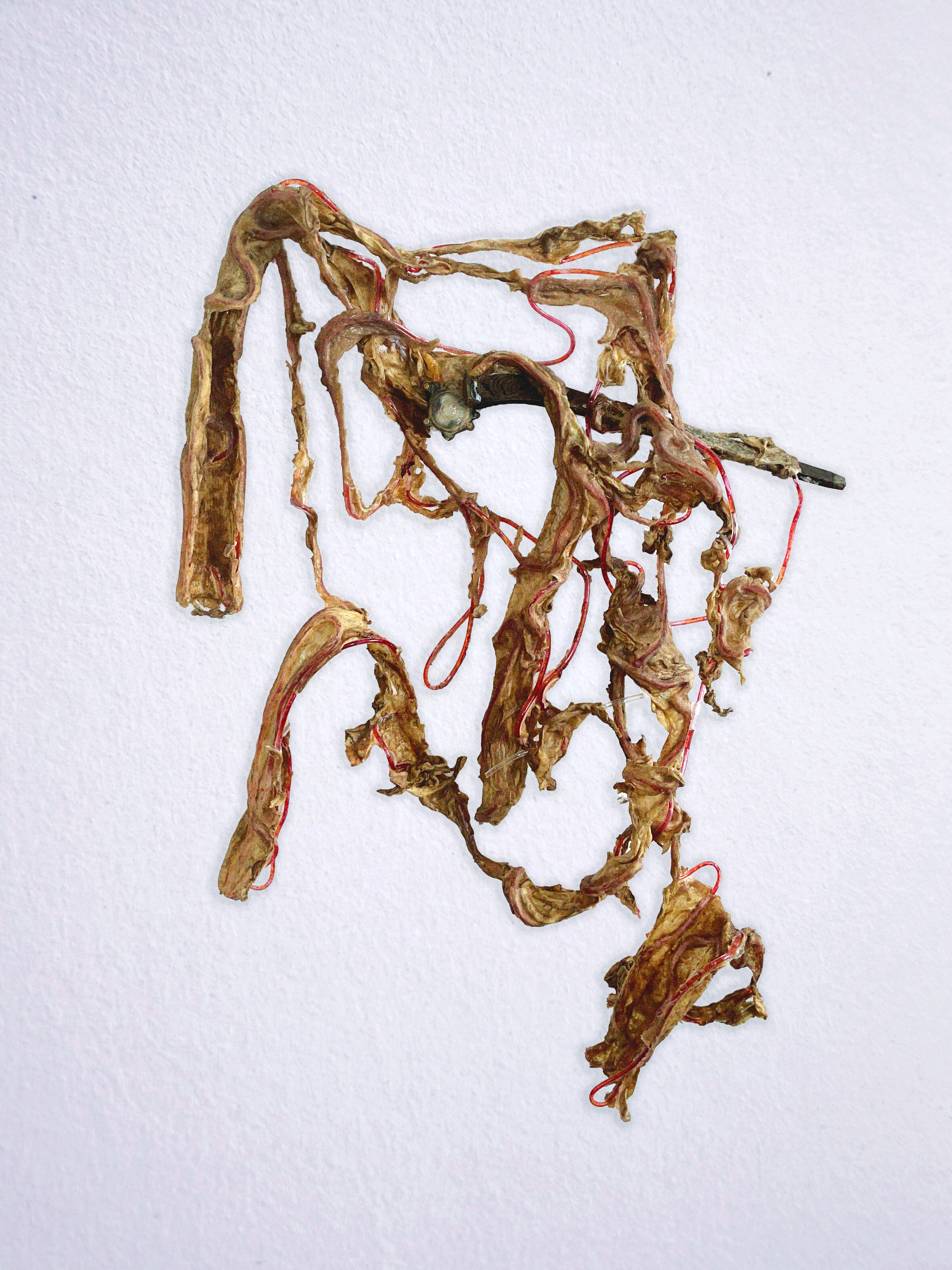
„Thresh”
Kinetic Sculpture
Latex, PVC, Oil, Dye, Motor, Wire, Batteries, Plastic, Wood
2025
100x65x10cm
This wall-hanging explores the interplay between the organic and the technological in contemporary life. Circulated oil flows through the veins of latex, animated by a motor, emphasizing the materiality of both human and machine. It reflects the layered composition of modern existence, nature, nurture, and technology, inviting viewers to confront the ways we are constructed from, and dependent upon, our component parts. The work embodies a sense of fragmented embodiment, positioning the body and its mechanical extensions as interconnected, evolving systems.
.jpg)
„Claustrum”
Interactive Installation
PIR sensor, wire, single board computer, felted wool blanket
2025
70x70x180cm
Shrouded beneath a layer of felted wool, an unseen being stirs, its movements manipulating the fabric’s surface in a rhythmic struggle. Powered by a single board computer running code and activated by a PIR sensor, the sculpture reacts to the presence of the observer. Claustrophilia delves into the psychological tension between comfort and confined space. While the being inside may be content, this kinetic installation invites viewers to confront this perspective as an onlooker, provoking an instinct to either intervene or retreat. “Claustrum” prompts reflection on the boundaries between the animate and inanimate, comfort and disquiet, intimacy and alienation.
.jpg)
„ELIZA”
Interactive Installation
Fiberglass, wire, single board computer, infrared sensors, aluminium, rubber, speakers
2024
140x130x20cm
ELIZA explores the building blocks of human language in a form that invites viewers to grapple with meaning—or its absence. The installation utilizes a Raspberry Pi microcontroller running code, an independent power source, wires, speakers, and infrared sensors that detect viewer proximity, all housed in a molded fiberglass shell. As visitors approach the vessel, the sensors measure the distance of the viewer and trigger audio recordings measured out to specific intervals—nasal hums, guttural clicks, and soft approximates—recited by classical musician William Socolof who was commissioned for this work.This fragmented vocalization evokes a digital theremin of human sound—precise but devoid of syntax or semantics. These phonemes are divorced from the context and grammar that typically give them purpose. Drawing inspiration from Peter Ladefoged’s phonetic studies and the “ELIZA effect” coined by Joseph Weizenbaum, the piece challenges the viewer’s impulse to interpret, to imbue sounds with meaning even when none is given. In this void, ELIZA questions our innate desire to find coherence, especially in an era of AI and deep learning where the line between human and machine language blurs. ELIZA becomes an introspective experience, prompting viewers to confront the elemental DNA of their language—disembodied, raw, and eerily familiar.
.jpg)